

Presenting a Longevity Score to Skeptical Patients
Clinics can improve patient buy-in by framing longevity scores as transparent synthesis layers rather than black-box verdicts.
Understanding longevity data and what it means for your health
Clinics can improve patient buy-in by framing longevity scores as transparent synthesis layers rather than black-box verdicts.

Not all biological age tests carry equal clinical signal; this guide compares GlycanAge with other options through a longevity decision lens.
hsCRP is valuable for longevity planning, but only when interpreted with context, repeat timing, and companion biomarkers.

ApoB is one of the highest-value biomarkers in longevity medicine, but many people still test it too infrequently or without context.
You can add longitudinal longevity risk scoring without replacing panel vendors or rebuilding operations. Here is a practical rollout model.

Wearables produce massive data streams, but only a small set of metrics reliably improves longitudinal longevity scoring.
Homocysteine is a high-signal biomarker for vascular and cognitive risk, yet it is often ignored in routine longevity planning.
In longevity medicine, point-in-time data is necessary but insufficient. This post explains why longitudinal scoring changes clinical decisions and patient behavior.

LifeIndex weights a focused set of biomarkers with strong longitudinal signal quality. This post explains the current top eight and why they matter.

Longevity clinics are strong at collecting data and weakly equipped for longitudinal synthesis. This post explains why a scoring layer is now operationally necessary.

A biological age test can tell you whether your body is aging faster or slower than the calendar. But real progress comes from pairing that result with a longevity score, a healthspan score, and a repeatable protocol you can actually sustain.

A biological age test can be useful, but it only shows one slice of the picture. A synthesized healthspan score gives you a clearer view of how your body is functioning across systems and over time.

A longevity score distills hundreds of biomarkers, wearable signals, and lifestyle variables into a single number that says whether your healthspan trajectory is improving or eroding. Here's how it works and how to use it.
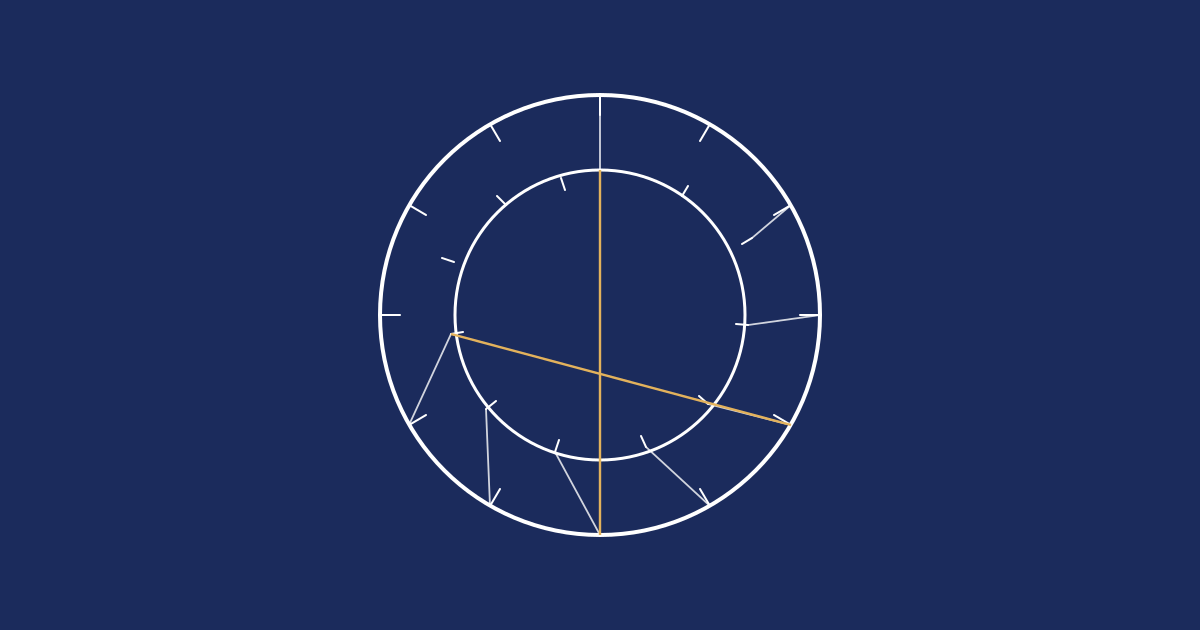
Chronological age counts years. Biological age measures how your body is actually functioning. Understanding the difference is the first step toward meaningful healthspan improvement.

Health is not defined by one lab result, one sleep score, or one wearable reading. Long-term trajectory is what reveals whether resilience is improving or eroding.

Improving healthspan is less about chasing isolated metrics and more about strengthening whole-system resilience. Here’s what actually moves the needle.

A true healthspan score must integrate biomarkers, functional capacity, recovery, and long-term trends. Here’s what goes into designing a meaningful longevity index.

Health data feels precise, but isolated metrics often mislead. Here’s why most health numbers lie—and when they actually become useful.
Your health data is everywhere, but your health story is nowhere. Meet LifeIndex, a unified healthspan score that turns fragmented metrics into one clear longevity signal.